What are drones capable of?
We’ve seen UAVs used for target practice, surveillance, kamikaze missions, but in my opinion we have only truly began to explore the functionality and purpose of drones in the last decade past simplistic purposes. This presentation so far has been a lead up to the idea that drones have evolved past the point of being of military purpose and is now a common household item, like the upcoming Tornyol mosquito drone that Dom shared with us. It is inevitable that drones will continue to proliferate and enter many other topics and industries. I wrote about the two large revolutions, A. Low’s first radio UAV and DJI Phantom as the two big moments that led us to where we are now with drones. Will there be another one soon? This is a deep dive into some examples that reinforce the belief that drones will only continue integrating themselves further into the daily life and advancement of other pursuits, and the possible positive and negative implications of these ideas.
The RoboBee
In 2013, around the same time the DJI Phantom was released, Harvard also unveiled a new project: RoboBee. A drone smaller than your thumb, with wings that flaps at 120 times a second, and weighs 0.0028 ounces. Funded by the Department of Defense, the RoboBee is a work-in-progress at swarm intelligence and mass surveillance in urban environments. As of right now, the most widely used smallest drone in the military is the Black Hornet Nano, around the size of a palm and weighing 0.7 ounces. With the RoboBee, reconnaissance can go essentially unnoticed with this robot that is only the size of a bumblebee.
There is also the potential for holistically good purposes. Christian Chan, a current Harvard graduate student, sees the biggest purpose of these drones to be for artificial pollination, pollinating future farms and gardens.
Below is a short video of when the Robobee was released. As you can see there are still major limitations that still exist to this day, namely the wire still attached to the drone, due to the problem of supplying power. Making a battery that can last for extended periods of time increases the weight, which increases the need of a stronger flight system, meaning a bigger battery, meaning stronger flight system, etc.
Ingenuity and Dragonfly
NASA has been launching drones for decades now, whether it’s to survey a celestial body or to travel across Mars. The most recent notable spacecraft was Ingenuity, a rotor-based UAV that landed on Mars alongside the Perseverance rover. It was a helicopter that was meant to be a quick demonstration and test, making 5 flights to study terrain, flight capabilities and navigation techniques with pre-planned autonomous flight paths. It quickly succeeded in the 5 flights, and then performed 67 more flights in the next three years, pushing the envelope with over 10x the amount of flights it was expected to achieve. The first rotorcraft to be sent to space had such a positive success that it quickly led to the development of Dragonfly.
Dragonfly is the newest helicopter spacecraft, currently being made to send to Titan, Saturn’s Moon. Titan has a atmosphere incredibly similar to Earth’s, carbon-rich with a surface primarily made of frozen water, potentially having a recipe for what is known as primordial soup. To further study the possibilities of Titan, Dragonfly is expected to fly there in 2028 and study the habitability of the moon with a variety of instruments built into it’s body. The rotor-based flight system allows for repeated landings and launches to explore various areas of the moon without having to deal with difficult terrain. This spacecraft is one of the most important in the last couple decades, exploring the viability of a second celestial body capable of hosting life.
Amazon Prime Air
It would not be the future of drones if you failed to talk about delivery drones. Amazon Prime Air was quickly founded after the DJI Phantom in the same year, with them seeing the immediate potential of drones for their system. The problem lies in the actual execution. We talked earlier this semester about BVLOS regulations and the possible loosening of said regulations based on FAA’s proposed rule making, which I believe that company lobbying like Prime Air played a large part in this proposal. Every single delivery would be BVLOS, entirely changing/bypassing the current regulations. The cost of the delivery in 2022 was estimated to be around $500, and expected to drop down to $63 by 2025. A package delivery right now is estimated to be around 4-5 dollars. Since creation in 2013, Prime Air has only launched in an handful of cities in the United States, and subsequently also shut down in most of those cities like College Station, Texas. and Lockeford, California.
Conclusion
While drones are advancing at a rapid pace, now from hot air balloons to thumb-sized drones and spacecraft exploring a moon nearly a billion miles away, I believe there will always be a military lens attached to the idea of drones, with even the RoboBee funded by the Department of Defense. UAVs began and advanced rapidly due to conflict and wars, and has continued to advance based on those goals. There are concerns that drones are now creating perpetual conflict due to their reliability and the advantage for losing sides to hold off larger entities with drones. Ukraine has turned the tides in this fashion with their use of drones, from military models to even a DJI Mavic 3.
But, like I said before, DJI has changed what the drone means to the general public, dominating over 70% of the global market share. I believe they had direct impacts on how rotorcraft are imagined and influenced projects like Ingenuity and Dragonfly. With drones now being perceived as something beyond just militaristic objectives, this is where we can truly advance the field by looking at topics like surveying and disaster relief where we have not created perfected or efficient systems.
This presentation is also pushing towards the opinion that severely restrictive laws and rules like the possible DJI ban will only inhibit new ideas and technology. If we had restricted access to this in 2013 with the Phantom release, would drone technology still be where it is today? As with every other field, creating a collective mind and public domain of knowledge will only benefit drones in the long run.
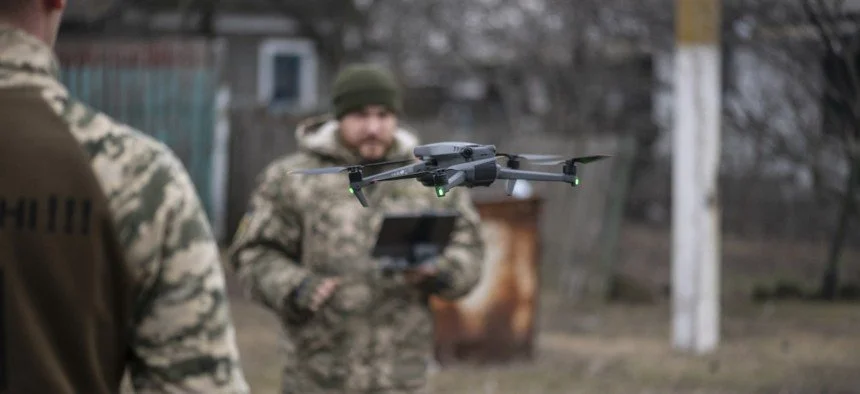
Ukrainian soldiers practice with a DJI Mavic 3.